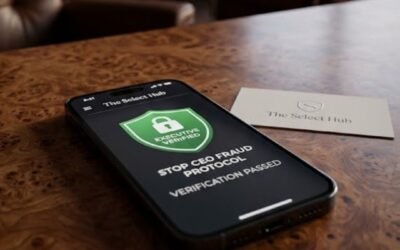

You’re about to wire €300,000 as the down payment on your dream home. Your closing attorney (or notary, or conveyancer) emails you the IBAN and says, “Please transfer today so we can complete on time.”
Looks legit, right?
Here’s the problem: wire-fraud scammers aren’t random amateurs. They’re often sophisticated criminals who intercept real email threads between real buyers, real agents, and real legal teams—then swap the bank details at the exact moment you’re busy, stressed, and time-boxed.
And once that money leaves your account, it’s usually very hard to recover.
So this is my “digital armor” approach: a closing-day protocol designed for high-value property deals where speed matters—but mistakes cost fortunes.
The scam that hits hardest: email interception right before closing
Luxury real estate transactions are a perfect target for one reason: large wires happen on predictable days. Scammers don’t need to guess. They just need access to the conversation.
They’ll monitor for telltale phrases like:
- “closing date”
- “funds required”
- “deposit / down payment”
- “escrow / client account”
- “IBAN / wiring instructions”
Then they strike right before completion with an “updated” message:
- “We’ve changed accounts due to an audit.”
- “Use this new IBAN for today’s transfer.”
- “Please do not delay—closing will fall through.”
The scary part is that the email can look perfect: logo, signature, tone, even the “From” name. The only thing that changes is the account number.
If you take one thing from this article:
Never wire funds based on emailed instructions unless you verify them via an independently verified call-back.
Not replying to the email. Not texting. Not calling the number in the email signature.
A real call. To a real number. You looked up yourself.
How the scam actually works (BEC in plain English
This is basically Business Email Compromise (BEC), tuned for real estate.
Compromise → monitor → spoof → redirect → disappear
- They compromise an account (buyer, agent, attorney, assistant—anyone in the chain) through phishing, weak passwords, reused passwords, or exposed mailboxes.
- They monitor silently, reading the thread and learning the deal: names, dates, property address, amounts, who pays whom, and when.
- They send fake bank details at the most believable moment—often pretending to be the closing attorney or escrow provider.
- You wire the money to the attacker’s account.
- They move it fast, often through multiple accounts and jurisdictions.
The fraud is rarely “technical wizardry.” It’s timing + psychology.
The non-negotiable rule: never wire from emailed instructions
I’ll say it bluntly: Email is not a safe channel for bank details by default.
Email gets forwarded. Mailboxes get compromised. Threads get copied to personal accounts. Assistants step in. Phones auto-complete addresses. A tiny slip becomes a catastrophe.
The only verification that counts: callback to an independently verified number
Your verification standard should be:
- Use a phone number you already had on file before the deal, or
- Look up the number independently (official website, verified directory, prior engagement letter, business card you received in person)
Then verify:
- beneficiary name
- bank name
- IBAN/account number (read it out slowly)
- reference/payment description
What NOT to trust
- Phone numbers inside an email asking for a wire
- Links in that email (“click here to confirm”)
- A new “assistant” introduced last minute
- A “Reply-To” that looks nearly identical
- “We changed accounts today” stories under pressure
If anyone pushes urgency, treat it as a red flag. Legit professionals would rather be mildly inconvenienced than have a client lose €280,000 in 30 seconds.
The Closing-Day Protocol (fast, practical, and designed for million-euro deals)
This is the part most guides hint at, but don’t operationalize. Here’s the short version that actually works.
The 5-step verification workflow
- Freeze bank detail changes
- Rule: “No bank detail changes within X days of closing unless verified by two channels.”
- Two-person check
- One person reads the IBAN; another person verifies it from the source of truth (secure vault / secure channel).
- Independent callback verification
- Confirm bank details with the law firm/notary/escrow via a verified number.
- Test transfer (when feasible)
- For very large sums, consider a small test transfer if timelines allow (not always possible, but worth it when it is).
- Confirm receipt using a separate channel
- After the wire is sent, confirm receipt by phone (again: independently verified number).
Red flags checklist (closing edition)
- “Updated IBAN” or “new client account”
- New email domain, extra letter, different TLD
- Slightly different tone (too formal, too urgent, unusual punctuation)
- Pressure to act “right now”
- “Don’t call—I’m in court / traveling / in a meeting”
- Requests to bypass your normal process (“just this once”)
Secure channels that don’t slow the deal
This is where I stop relying on “be careful” and start building a system that makes the safe behavior the default.
Proton Mail for IBANs (mandatory channel policy)
My preferred policy for high-value deals is simple:
IBANs and wiring instructions are only shared via encrypted email—mandatory.
That’s where Proton Mail fits perfectly:
- Create a dedicated Proton Mail address for closings or for the deal team.
- Use it only for sensitive instructions (IBAN, escrow details, IDs, completion statements).
- Pair it with a call-back verification step.
Important nuance: encrypted email doesn’t remove the need to verify—but it drastically reduces the odds of easy interception or thread hijacking.
If you do one operational change this year, make it this:
Stop sending bank details in standard email threads.
NordLayer for secure remote work and controlled access across parties
Luxury deals rarely happen while everyone is sitting in the same office. People are traveling. Assistants are coordinating. Teams work from hotels, brokers’ offices, or personal devices.
That’s where NordLayer becomes a real “deal shield”:
- It gives teams secure access paths and reduces exposure when working on untrusted networks.
- It supports a zero-trust posture: access based on identity, device posture, and policy.
- It’s especially useful if your family office, legal team, or brokerage wants consistent controls without rebuilding enterprise IT.
This matters because the most expensive deals often have the messiest comms surface:
agents + lawyers + notary/escrow + assistants + family office staff + multiple inboxes.
Incident response: what to do if you suspect interception (or already sent the wire)
If you suspect something is off, speed beats perfection.
The first 10 minutes
- Call your bank immediately
- Ask for the fraud team. Ask if the transfer can be recalled, frozen, or flagged.
- Call your closing attorney/notary/escrow
- You need to know whether the legitimate details match, and whether their systems may be compromised.
- Preserve evidence
- Save the suspicious email(s), headers if possible, timestamps, and the bank transfer confirmation.
- Escalate internally
- If you’re a family office: inform the principal/CFO/security lead. Don’t let shame delay action.
Reporting and recovery
Depending on jurisdiction, report to:
- local police / national cybercrime reporting portal
- your bank’s fraud channel
- any relevant regulatory or industry reporting options
One more point that matters: don’t be embarrassed. These scams catch smart people—often because they’re timed for maximum pressure.
Conclusion
If you’re moving millions in a luxury real estate transaction, the biggest risk often isn’t the property, the survey, or the title work.
It’s a single email.
So build “digital armor” that doesn’t depend on someone being perfect under pressure:
- No IBANs in standard email threads
- Proton Mail mandatory for bank details
- Independent call-back verification
- Two-person checks for high-value transfers
- NordLayer for secure team access during remote work
- Fast incident response if anything feels off
Your closing should feel boring. Predictable. Procedural.
That’s what secure looks like.
Real Estate & Wire Fraud FAQ
Because that’s when the largest transfers happen and the pressure is at its peak. Attackers use extreme urgency and highly realistic context stolen from real email threads to deceive you.
Always use a dual-layer secure channel: Encrypted email (like Proton Mail) combined with an independent voice verification via a pre-verified phone number.
Never trust the numbers in the email. Use a phone number you have independently verified and confirm the IBAN or account details line-by-line with the authorized person.
Look for last-minute changes, artificial urgency, instructions “not to call”, and tiny mismatches in the sender’s domain or email address.
Seconds count. Call your bank’s fraud department immediately to freeze the transfer, then notify your closing team and report the incident to local cybercrime authorities.

Bespoke Implementation
Secure corporate communications under Swiss jurisdiction.