
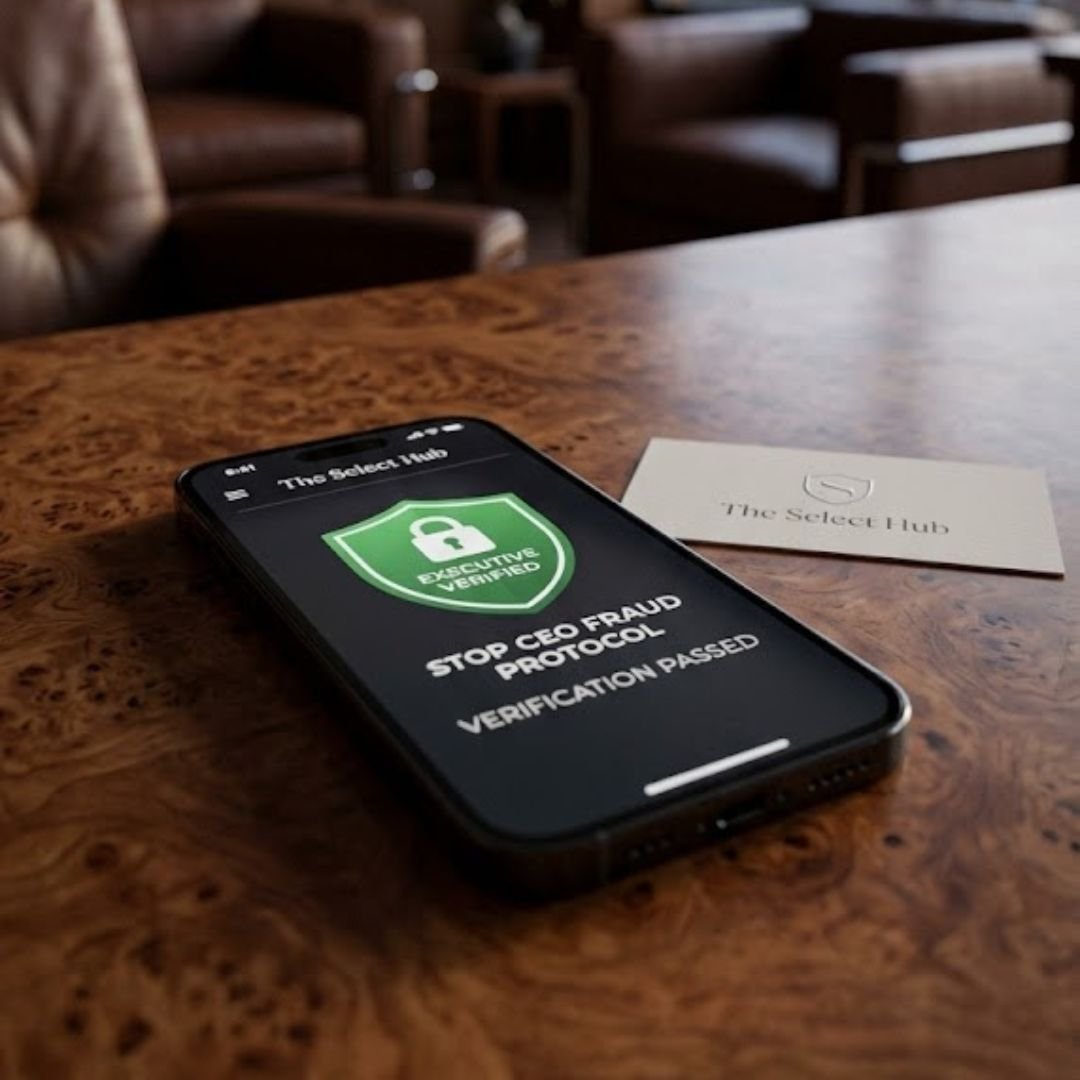
A familiar voice used to mean something. Now it doesn’t.
AI voice cloning (“deepfake vishing”) lets attackers impersonate a CEO, family member, or board chair well enough to trigger the oldest weakness in any organization: urgency + authority + secrecy. Kaspersky puts it bluntly: a familiar voice is no longer proof a call is real, and the safest response is to end the call and verify independently.
This article is the C-suite-ready protocol that makes voice deepfakes boring to defeat—without slowing the business down. It’s built around two pillars:
- Verification that can’t be gamed by voice
- Authentication that can’t be phished (U2F security keys via NordPass)
And yes—WhatsApp voice notes are part of the battlefield, which is why I position a WhatsApp Advisory as a governance + hardening layer for “urgent” comms.
The new CEO fraud: when the voice is real but the person isn’t
Attackers don’t need Hollywood tech. They need a few seconds of clean audio, which they can often collect from:
- podcasts and interviews
- keynote clips
- social media posts
- even voicemail greetings
Then they run the playbook:
- Collect voice samples
- Generate a voice clone
- Call (or send a voice note) with a high-pressure story
- Demand action now, “don’t loop anyone in,” “confidential deal,” “wire today”
This is social engineering with better costumes.
And it scales: deepfake-enabled impersonation has already produced major losses. The World Economic Forum and other reporting describe the Arup incident where a deepfake video call led to about $25M in fraudulent transfers—proof that “impersonation realism” can break internal trust models.
The deepfake vishing attack chain (plain English)
Here’s the chain your finance team needs to recognize immediately:
Source audio → voice model → urgent instruction → payment
- “It’s me. I’m in a meeting. I need you to do a wire now.”
- “This is time-sensitive. Do not call anyone else.”
- “I’ll explain later. Just execute.”
McAfee’s guidance frames this as the modern evolution of CEO fraud/BEC—except now the attacker can sound like the executive.
The escalation path
They’ll push you toward irreversible rails:
- wire transfers
- crypto
- gift cards
- “temporary” account changes
The method isn’t the point. The point is bypassing your normal verification loop.
The non-negotiable rule: no approvals by voice, ever
This is the single line that stops most losses:
No payment approvals by voice call or voice note. Ever.
Not for the CEO. Not for the board. Not for “just this once.”
Because “but it sounded exactly like them” is no longer evidence.
The executive can still initiate a request by voice—but approval must happen out-of-band and in writing through a controlled workflow.
The Executive Verification Protocol
Fast, repeatable, CFO-friendly
This protocol is designed to work in the real world where:
- executives are busy
- finance teams are under pressure
- attackers weaponize urgency
1) The Call-Back Rule (out-of-band verification)
If an executive requests a payment by call/voice note:
- Hang up (politely).
- Call back using a pre-saved, pre-verified number (not a number provided in the message).
- Confirm the request using a fixed verification script:
- amount
- beneficiary
- timing
- reason category (not full details—just enough to validate)
Important: If they refuse a call-back, treat it as malicious.
2) Two-Person Approval (no solo heroics)
For any “urgent” transfer:
- Initiator ≠ approver
- Approver must verify independently
- If it’s truly urgent, it can survive 90 seconds of verification
3) Challenge-Response (“Safe Word”)—but make it professional
“Safe words” work, but executives hate cringe. So don’t make it childish.
Use:
- a rotating code phrase stored in a shared vault (changes monthly), or
- a “verification question” only your finance team and the executive office can answer quickly
Kaspersky explicitly recommends verification questions / safe phrases for these scams.
4) The Stop-The-Line Script (what finance says)
Give your finance team a sanctioned sentence they can always use:
“Policy requires call-back verification and dual approval for any urgent transfer. I’m initiating the verification now.”
This removes emotion and makes it procedural.
Hardening the channels attackers use
WhatsApp Advisory
Voice notes + group chats + “urgent requests” are exactly where deepfake vishing thrives, because the environment is informal and fast.
Your WhatsApp Advisory (positioned as governance + operational hardening) should cover:
- who is allowed to request payments (and where)
- how voice notes are treated (always “untrusted” for approvals)
- how to handle “new number” messages
- how to verify identity when the channel itself is compromised
The key is not “ban WhatsApp.” It’s design WhatsApp so it can’t authorize money.
NordPass + U2F security keys (phishing-resistant MFA)
Deepfake voice scams often pair with account takeover attempts:
- email compromise
- finance portal compromise
- password reset attempts under pressure
That’s why executives and finance roles should use phishing-resistant MFA, including U2F hardware security keys, for:
- password vault
- banking and payment systems
- finance workflows
Position NordPass here as the control plane to enforce strong authentication hygiene (vault + MFA discipline), and anchor U2F as “the seatbelt” for your crown-jewel accounts.
If it already happened: the 15-minute containment plan
If someone suspects they complied—or almost complied—treat it as an incident immediately.
Minute 0–5: Freeze
- Freeze the payment or recall if possible
- Notify bank/treasury ops immediately
Minute 5–10: Preserve evidence
- Save the voice note/call details
- Capture message metadata, numbers, timestamps
- Don’t delete anything yet
Minute 10–15: Contain accounts
- Lock down executive email accounts
- Review sign-in activity
- Rotate credentials if there’s any chance of compromise
Then run a post-incident upgrade:
- tighten approval thresholds
- enforce U2F
- re-train on the stop-the-line script
Deepfake & CEO Fraud Prevention FAQ
They don’t “hack” the finance systems; they exploit urgency, authority, and secrecy to bypass standard verification. Attackers use AI-cloned voices to simulate a high-pressure request from a known executive.
A structured call-back to a pre-verified number combined with dual approval. When rehearsed, this protocol takes under two minutes and prevents the vast majority of impersonation fraud.
Absolutely. For high-risk roles, hardware keys are essential because they are designed to resist phishing and the account-takeover routes that often fuel impersonation and deepfake-led fraud.
Use a "stop-the-line" script: pause the conversation, trigger a secondary call-back verification via a known channel, and strictly require dual approval for any transfer—no exceptions.

Bespoke Implementation
Secure corporate communications under Swiss jurisdiction.